

What Is Custom Card Printing and Who Needs It?
Custom card printing refers to the process of designing and manufacturing custom printed cards tailored to a brand, product, or specific application. Instead of using generic designs, businesses and creators work with a professional custom card manufacturer to produce cards with unique artwork, branding, materials, and finishes. This allows companies to create products that match their brand identity while ensuring consistent quality in bulk production.
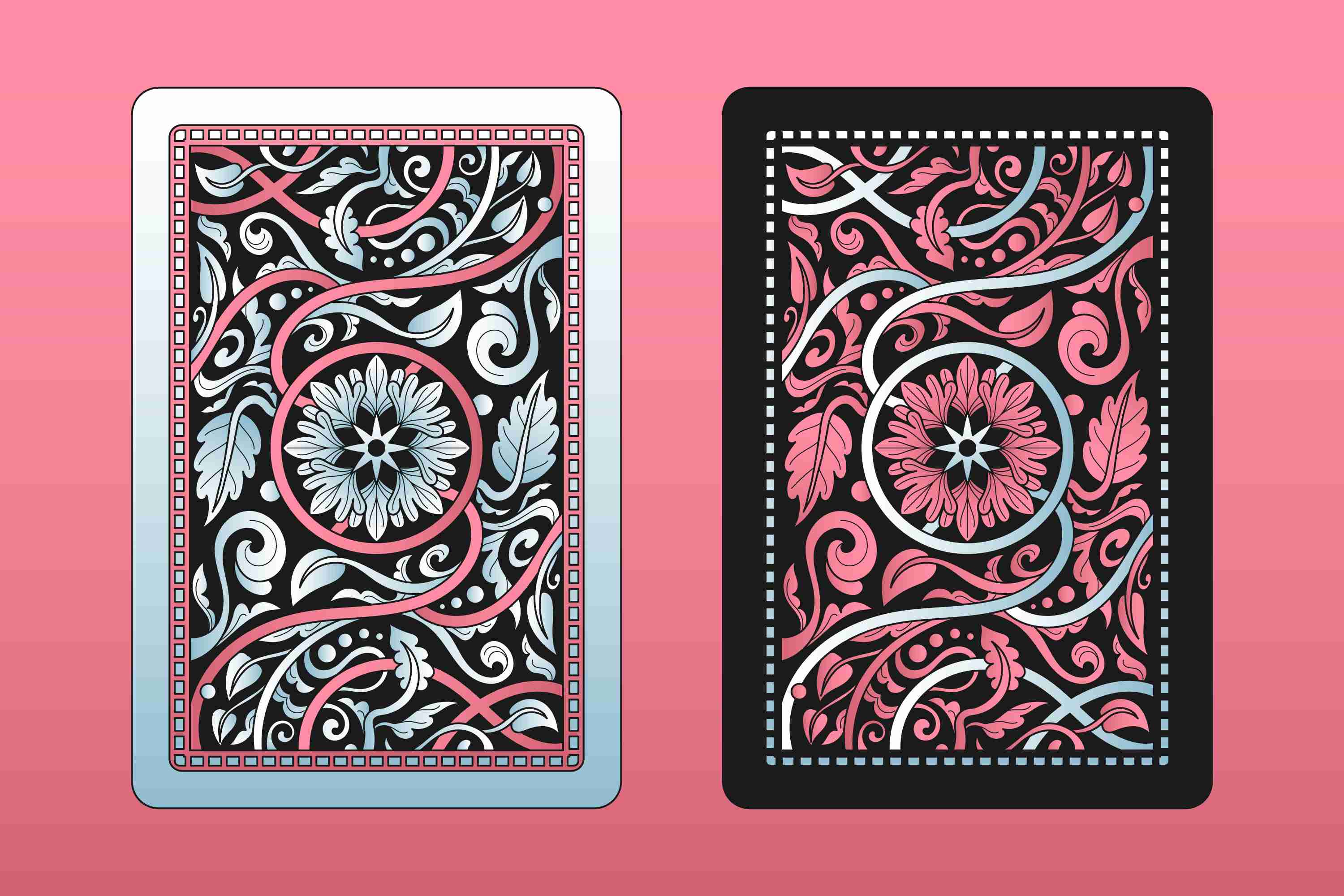
A reliable custom card manufacturer typically offers full-service production, including card material selection, printing techniques, finishing options, and packaging solutions. Many brands also partner with an experienced supplier for OEM production, especially when they need custom printed cards at bulk quantities for retail or distribution.
Today, custom card printing is widely used across multiple industries. One of the most popular applications is custom tarot cards, where creators design unique tarot decks for spiritual practices, online stores, or publishing businesses. These cards often require premium cardstock, special finishes, and customized packaging to enhance the user experience.
Another major category is custom playing cards, which are commonly used by game publishers, casinos, promotional brands, and entertainment companies. Businesses often use custom printed playing cards for branded merchandise, marketing campaigns, or retail products.
The tabletop gaming industry also relies heavily on custom card printing. Developers frequently produce custom card games that include hundreds of printed cards with detailed artwork and gameplay instructions. Working with a professional custom card manufacturer ensures these cards are durable enough for repeated gameplay while maintaining accurate color reproduction.
In the collectibles market, custom TCG cards and trading cards are widely produced for hobby communities, game developers, and promotional campaigns. These cards often include premium finishes such as foil stamping or holographic effects to increase collectability and visual appeal.
Finally, custom flash cards are commonly used in education and training. Schools, publishers, and educational brands create custom printed cards to develop learning tools for language study, early childhood education, and professional training programs.
Because of their versatility, custom card printing has become an essential manufacturing solution for businesses that need branded, durable, and professionally produced card products. By working with an experienced custom card manufacturer, companies can transform creative ideas into high-quality card products ready for retail, distribution, or promotional use.
Types of Custom Cards You Can Print
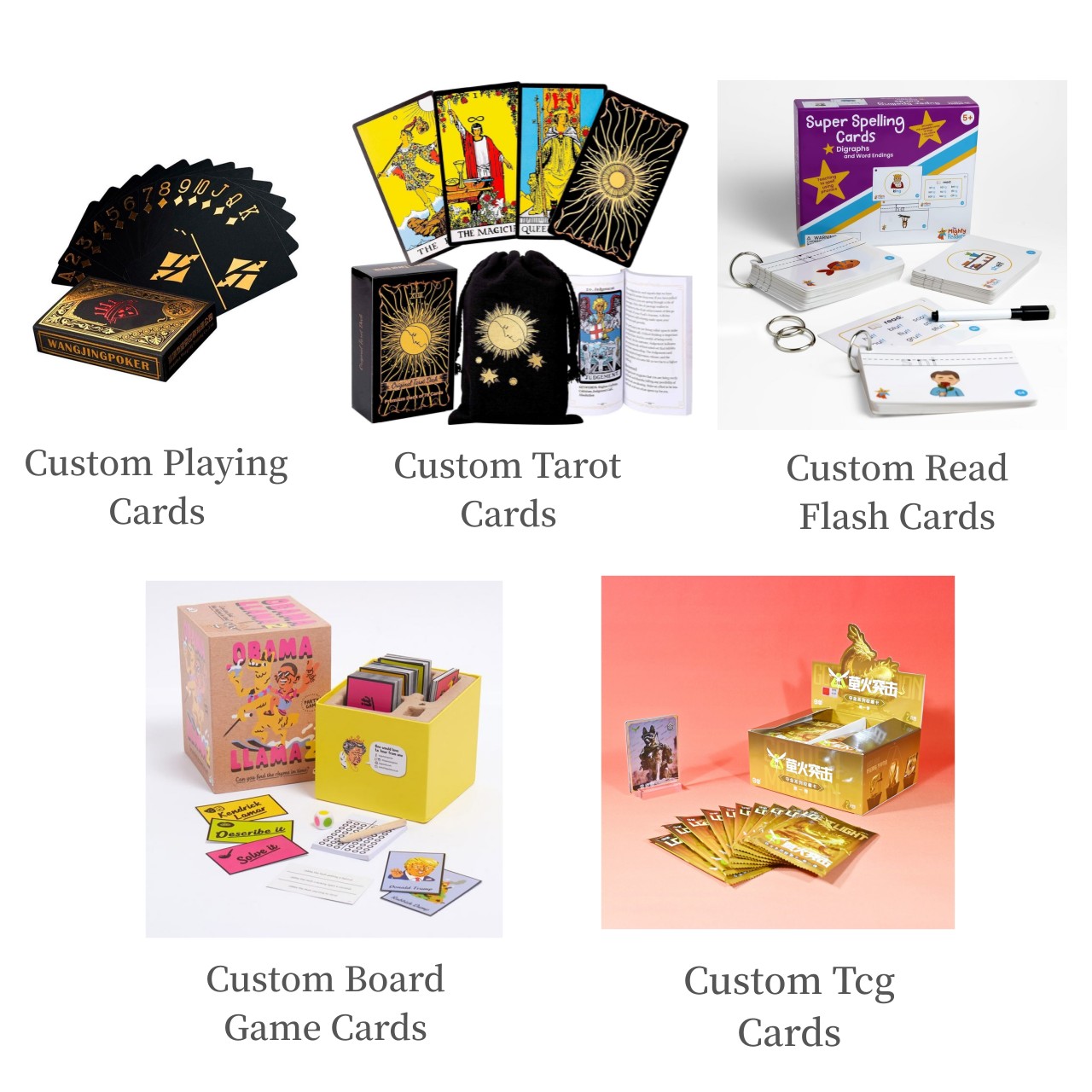
Custom printing cards are used across many industries, from entertainment and education to marketing and retail. Businesses, creators, and publishers often look for a reliable custom card manufacturer or custom card printing supplier to produce high-quality cards in bulk. Understanding the different custom card types available can help you choose the right solution for your product, brand, or project.
Below are some of the most popular custom printing cards used by businesses and creators today.
Custom Tarot Cards
Custom tarot card printing is widely used by tarot brands, spiritual creators, and independent publishers launching their own tarot decks. A professional custom card printing factory can produce tarot cards in various sizes, paper stocks, and finishes to achieve a premium feel.
Most tarot decks use thicker cardstock with coatings such as matte, linen, or UV finishes to ensure durability during frequent shuffling. Many brands also combine custom tarot card printing with custom tarot packaging, including rigid boxes or magnetic boxes, to enhance the overall product value.
For tarot creators looking to scale production, working with an experienced OEM card manufacturer helps ensure consistent quality and efficient bulk production.
Custom Playing Cards
Custom playing card printing is one of the most common applications in the custom printing cards industry. Businesses, entertainment venues, game designers, and promotional brands often order custom printed playing cards for retail products, marketing campaigns, or branded merchandise.
A professional custom card manufacturer can produce playing cards with different paper weights, coatings, and finishes such as linen texture or UV varnish to improve durability and shuffle performance. Many companies also combine custom playing card printing with branded tuck boxes or rigid packaging to create a complete retail-ready product.
For brands ordering in bulk, partnering with a custom card printing supplier allows you to access custom playing cards with stable quality and competitive pricing.
Custom Card Games
Many board game publishers and indie developers rely on custom card game printing to produce the cards used in their tabletop games. These cards are essential components of many strategy games, party games, and educational games.
A reliable custom card factory can support game creators with card size customization, special finishes, and packaging solutions tailored to the specific needs of the game. With professional custom card game printing, publishers can ensure that the cards are durable enough for repeated gameplay while maintaining high-quality printing for artwork and text.
Game creators often work with an experienced OEM card manufacturer to manage the entire process from design files to final production and packaging.
Custom Trading Cards (TCG Cards)
Custom TCG card printing is increasingly popular among collectible card brands, game developers, and fan communities. Trading cards require high printing precision and premium finishes to enhance collectability and visual appeal.
Professional custom card printing factories can produce custom trading cards with advanced printing techniques such as foil stamping, holographic finishes, UV coating, or embossed effects. These features are commonly used in collectible card games to create rare or special-edition cards.
Working with a specialized TCG card manufacturer also ensures that cards meet standard trading card dimensions, making them compatible with sleeves, binders, and game systems.
Custom Flash Cards
Custom flash card printing is widely used in the education industry, language learning tools, and training materials. Schools, publishers, and educational brands often produce custom flash cards to create engaging learning products.
With professional custom printing cards services, flash cards can be printed in various sizes with durable cardstock and protective coatings. Many education brands also pair custom flash card printing with custom packaging boxes to create organized learning kits for retail or classroom use.
By partnering with a reliable custom card manufacturer, educational companies can scale production and maintain consistent quality across large orders.
How to Design Custom Cards for Printing
Before starting custom card printing, a clear and professional custom card design is essential. Whether you are creating tarot decks, trading cards, or promotional cards, the design stage determines how well the final custom printed cards will look and function. Businesses, game developers, and publishers often prepare their files using a standard card printing template provided by the custom card manufacturer to ensure the artwork fits the printing specifications.
Understanding how to design playing cards or other types of cards mainly involves three key elements: choosing the correct card size, preparing the layout correctly, and exporting the files in the right format for production. When these elements are prepared properly, the custom card printing process becomes much smoother and helps avoid production errors.
Card Size and Dimensions
The first step in custom card design is selecting the correct card size. Different card categories follow different industry standards. For example, standard playing card dimensions are typically 63 × 88 mm (2.5 × 3.5 inches), which is widely used for poker-style cards. Tarot decks usually use a larger tarot card size, commonly around 70 × 120 mm, allowing more space for detailed illustrations.
For collectible games, TCG card size generally follows the trading card standard of 63 × 88 mm so that cards can fit into protective sleeves and storage binders. When working with a professional custom card manufacturer, clients can also request custom sizes depending on the product concept or branding requirements. Choosing the right dimensions early ensures the custom card printing project meets both design and usability expectations.
Card Layout and Bleed Area
Another important part of how to design playing cards is preparing the correct layout and bleed area. A standard card printing template usually includes three zones: the safe area, the trim line, and the bleed area. The safe area keeps important text or graphics away from the edges, while the bleed area allows background artwork to extend slightly beyond the final cut line.
This layout system prevents white edges from appearing during the custom card printing process. When creating custom printed cards, designers should ensure that all important elements such as logos, icons, and numbers stay within the safe zone defined in the card printing template. Proper layout preparation is especially important for detailed artwork used in tarot decks, playing cards, and trading cards.
File Formats for Card Printing
The final step in custom card design is preparing the correct file format for production. Most custom card manufacturers recommend submitting print-ready files in formats such as PDF, AI, or PSD with high resolution (usually 300 DPI). These formats preserve image quality and ensure the colors appear correctly during the custom card printing process.
Designers should also convert fonts to outlines and embed images before sending files to the card printing factory. Following these technical requirements helps reduce errors and ensures that the final custom printed cards match the original design. By working with a professional custom card manufacturer, brands and creators can confirm that their files meet all printing specifications before mass production begins.
Best Card Stock and Materials for Custom Card Printing
Choosing the right custom card paper is one of the most important decisions in the custom card printing process. The quality of the paper directly affects durability, shuffle performance, print clarity, and the overall feel of the final custom printed cards. Whether you are producing tarot decks, trading cards, flash cards, or game cards, selecting the best card stock for playing cards or other card products helps ensure the cards are strong enough for repeated use while maintaining high visual quality.
Professional custom card manufacturers usually offer multiple playing card cardstock options designed for different applications. Thicker materials provide durability and a premium feel, while specialized coatings improve handling and surface protection. Understanding the different custom card paper options available can help brands and creators choose the most suitable materials for their projects.
Common Card Stock Types
Several types of playing card cardstock are commonly used in custom card printing. Standard card stock is widely used for promotional cards, flash cards, and educational materials because it offers good durability and cost efficiency. For higher-end products such as tarot decks and card games, premium custom card paper with layered construction is often preferred.
Many professional custom card manufacturers offer specialty playing card cardstock that includes inner core layers to improve stiffness and prevent light from passing through the cards. This type of material is often used for playing cards, trading cards, and other high-quality custom printed cards that require long-term durability.
Selecting the best card stock for playing cards or other custom cards depends on the intended use, budget, and desired product quality.
Card Thickness (GSM)
Another key factor when selecting custom card paper is thickness, usually measured in GSM (grams per square meter). Thicker playing card cardstock generally provides a more durable and premium feel, which is especially important for cards that will be frequently shuffled or handled.
For example, many custom card printing projects use cardstock between 300 and 350 GSM for standard decks. Higher-end products may use thicker custom card paper combined with lamination or coating to enhance strength and flexibility. When working with a professional custom card manufacturer, clients can choose the appropriate playing card cardstock thickness based on the card type, gameplay requirements, and budget.
Card Coating Options
Surface coatings also play an important role in custom card printing, as they affect both durability and tactile experience. A matte card finish is commonly used for tarot cards and educational cards because it reduces glare and provides a soft, smooth surface.
For improved shuffle performance, many premium decks use linen finish cards, which feature a subtle embossed texture that helps prevent cards from sticking together. This finish is popular for playing cards and many custom printed cards designed for tabletop games.
Another common option is UV coating cards, which add a protective glossy layer that enhances color vibrancy and protects the custom card paper from scratches or moisture. By combining the right playing card cardstock with suitable coating options, businesses can ensure their custom printed cards achieve both durability and professional visual quality.
Custom Card Finishes and Special Effects
Beyond paper quality and printing accuracy, card printing finishes play a crucial role in the overall appearance and value of custom printed cards. The right finishing techniques can enhance visual impact, improve durability, and create a more premium user experience. For many brands and creators, adding special effects during the custom card printing process helps differentiate their products in a competitive market.
Professional custom card manufacturers often provide a variety of card printing finishes that can be applied to playing cards, tarot cards, read flash cards, and other custom printed cards. These finishing options range from metallic effects to textured surfaces, allowing brands to create unique card designs that stand out visually while maintaining production quality.
Understanding the available card printing finishes can help businesses choose the right combination of materials and effects when planning a custom card printing project.
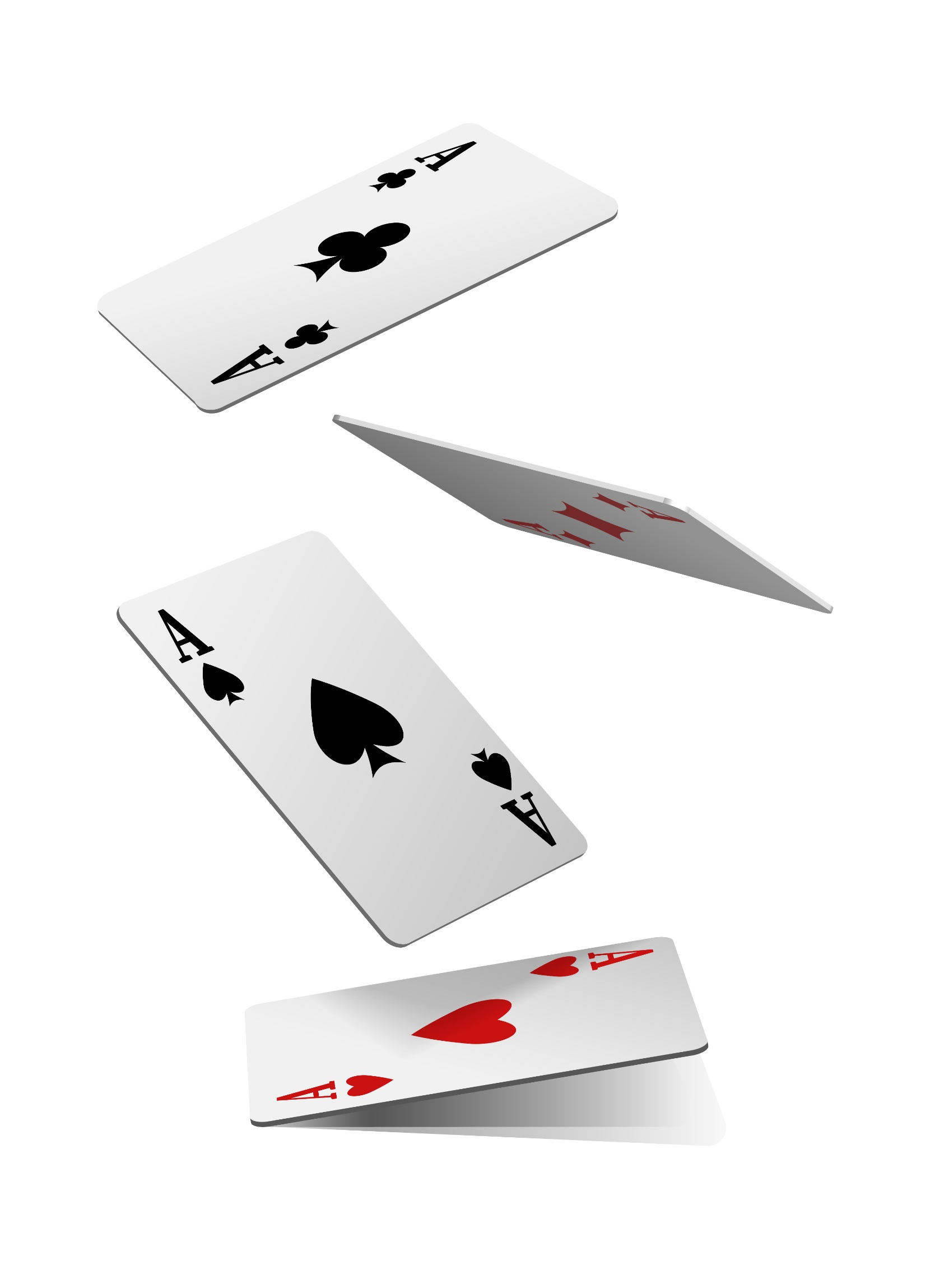
Foil Stamping
Foil card printing is one of the most popular premium finishing techniques used in custom card printing. This process applies a thin metallic foil layer to selected areas of the card using heat and pressure, creating reflective effects that enhance logos, borders, or decorative elements.
Gold and silver foils are the most commonly used options, but many custom card manufacturers also offer colored or holographic foils for more creative designs. Foil card printing is frequently used for tarot cards, collectible trading cards, and luxury promotional decks because it highlights key artwork elements while giving custom printed cards a more premium appearance.
When applied carefully, foil card printing can significantly improve the perceived value of a card product without affecting the durability of the underlying custom card paper.
Holographic Cards
Holographic effects are another popular option among advanced card printing finishes. In custom card printing, holographic cards are created by applying a reflective film layer that produces shifting rainbow colors when viewed from different angles.
This technique is widely used for custom TCG cards and collectible trading cards because the visual effect increases rarity and collectability. Many game publishers and collectors prefer holographic cards as special edition items within a deck or expansion set.
A professional custom card manufacturer can integrate holographic elements into specific parts of the card design, allowing brands to highlight important artwork or character illustrations while maintaining the structural integrity of the custom printed cards.
Matte Varnishing
Matte varnishing is a widely used option in card printing finishes, offering a smooth, non-glossy surface that reduces glare and enhances readability. In custom card printing, matte varnishing is applied as a protective coating over the custom card paper, creating a soft-touch feel while maintaining durability.
This finish is especially popular for tarot decks, educational cards, and premium custom printed cards where a subtle and elegant appearance is preferred. Compared to glossy coatings, matte varnishing provides a more natural look and is less prone to fingerprints, making it ideal for cards that are frequently handled.
Many custom card manufacturers recommend matte varnishing for designs with detailed artwork or text, as it improves visual clarity without excessive reflection. When combined with other card printing finishes, matte varnishing helps balance aesthetics and functionality in high-quality custom printed cards.
Embossing
Embossing is another technique used in premium card printing finishes. During the custom card printing process, embossing creates a raised texture on selected areas of the card surface, giving logos, patterns, or symbols a three-dimensional effect.
This finishing method is commonly used for luxury tarot decks and high-end playing cards for corporate or event promotion, because it adds tactile depth and visual elegance to custom printed cards. Embossing can also be combined with foil card printing to create striking metallic textures that further enhance the design.
Working with an experienced custom card manufacturer ensures that embossed elements are accurately aligned with the printed artwork and remain durable during handling.
Edge Gilding
Edge gilding is a decorative technique where metallic or colored foil is applied to the edges of custom printed cards. This finishing method is frequently used in premium tarot decks and collector card sets to create a visually striking edge when the cards are stacked together.
In custom card printing, edge gilding can use gold, silver, or colored metallic finishes depending on the design concept. Many creators choose this effect to elevate the presentation of their decks and create a luxury appearance that appeals to collectors.
When combined with other card printing finishes, edge gilding can transform standard custom printed cards into high-end products suitable for retail, collectors, and limited-edition releases.
Custom Card Packaging Options
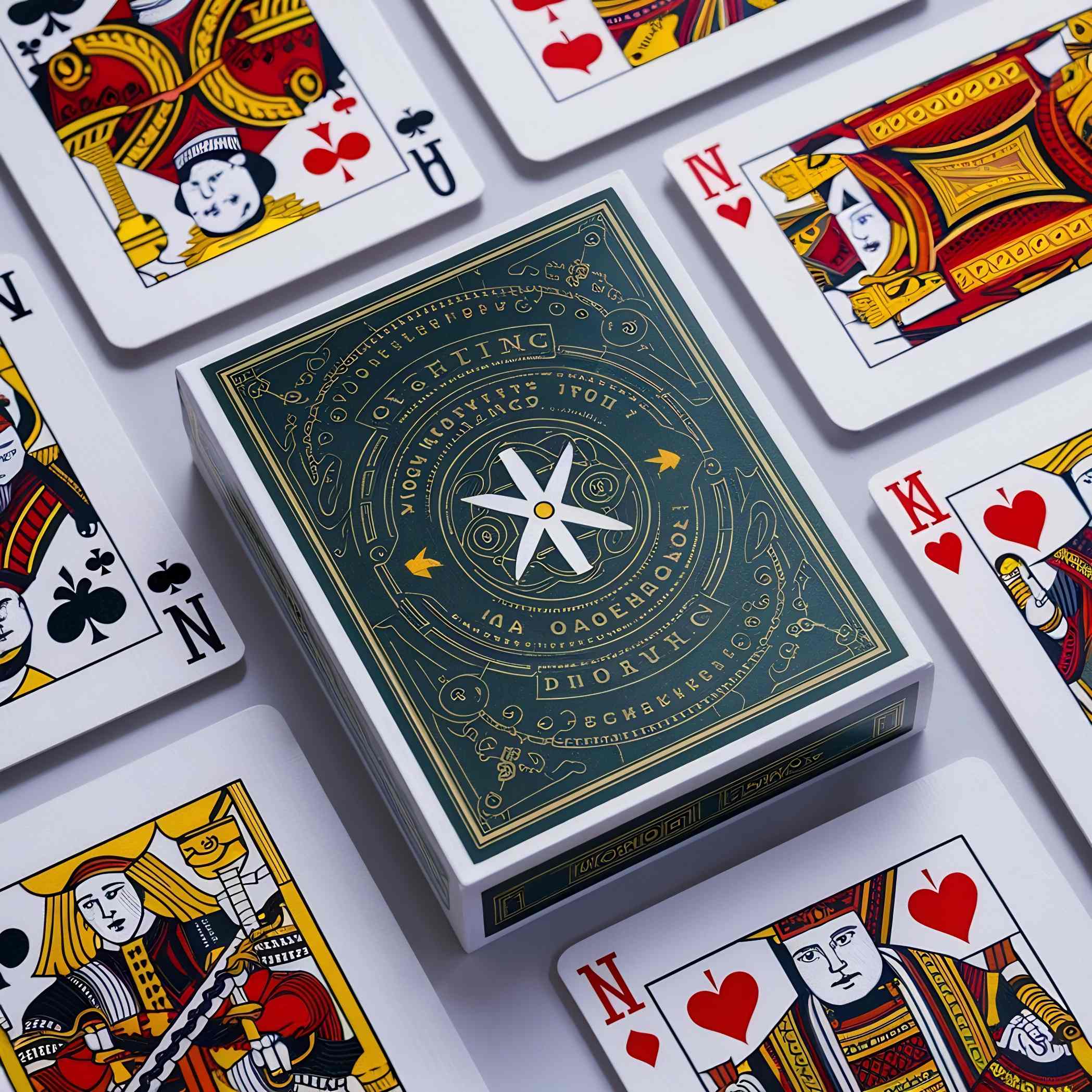
In addition to card design and materials, custom card packaging plays a critical role in product presentation, protection, and brand positioning. For many businesses, packaging is not just a container but a key part of the customer experience. Whether you are producing tarot decks, playing cards, or card games, choosing the right custom card packaging solution helps protect the cards during shipping while enhancing perceived value.
Professional custom card manufacturers usually offer a range of custom card packaging options to match different product types and market needs. From cost-effective solutions to premium retail packaging, selecting the right playing card box or tarot card packaging can directly impact both logistics efficiency and brand image
Custom Corrugated Boxes
Custom corrugated boxes are the most common and cost-effective type of playing card box used in custom card packaging. They are typically made from paperboard and feature a simple tuck-in flap for easy opening and closing.
Because of their affordability and practicality, tuck boxes are widely used for custom playing cards, promotional decks, and standard card games. Many brands choose printed tuck boxes as their primary custom card packaging solution when balancing cost and functionality.
Rigid Boxes
Rigid boxes are a premium custom card packaging option designed for high-end products such as tarot decks and collector card sets. Unlike standard playing card box styles, rigid boxes are made from thick, durable materials that provide stronger protection and a more luxurious feel.
This type of tarot card packaging is often used by brands that want to create a premium unboxing experience. Rigid boxes can also be customized with special finishes, making them ideal for retail-ready custom printed cards.
Magnetic Boxes
Magnetic boxes are another high-end custom card packaging solution, commonly used for luxury card products and gift sets. These boxes feature a built-in magnetic closure that provides a secure and elegant opening experience.
Compared to standard playing card box designs, magnetic boxes offer better structural strength and visual appeal. Many brands choose this type of tarot card packaging when targeting premium markets or limited-edition releases.
Card Game Packaging
For larger products, card game packaging is designed to hold not only cards but also additional components such as rulebooks, tokens, or accessories. This type of custom card packaging is widely used in board games and complex card-based games.
A professional custom card manufacturer can customize card game packaging based on the number of cards and components, ensuring both protection and efficient storage. Well-designed packaging also improves the overall user experience and helps brands deliver complete, retail-ready products.
How Much Does Custom Card Printing Cost?
Understanding the custom card printing cost is a key step for businesses planning to produce cards at scale. The total price of custom printed cards can vary significantly depending on specifications, order volume, and production requirements. Whether you are creating tarot decks, playing cards, or card games, working with an experienced custom card manufacturer(@Jinguan Printing.com) helps you get accurate pricing and cost-efficient solutions.
There is no fixed price for custom card printing, but most suppliers calculate costs based on several core factors, including card size, materials, quantity, and packaging. By understanding these variables, buyers can better control their custom card printing cost and optimize their budget.
Card Size
Card size is one of the first factors that affects custom card printing cost. Standard sizes, such as poker-size playing cards, are typically more cost-effective because they use optimized production templates. In contrast, custom dimensions may increase material waste and setup complexity.
For example, standard playing card printing cost is usually lower than fully customized sizes because manufacturers can streamline production. Choosing standard dimensions when possible is a simple way to reduce overall costs.
Card Stock and Materials
The choice of card stock also has a direct impact on pricing. Premium materials, thicker paper, and specialty finishes will increase the custom card printing cost, while standard cardstock options are more budget-friendly.
For projects that require durability and a high-end feel, many brands choose upgraded materials. However, balancing quality and budget is essential when planning large-scale custom card printing.
Printing Quantity
Order quantity is one of the most important factors in determining custom card printing cost. In most cases, the unit price decreases as the order volume increases. This is because setup and production costs are distributed across more units.
For example, bulk orders significantly reduce the average playing card printing cost per deck. Businesses looking for bulk production should always evaluate different quantity tiers to find the most cost-effective option.
Packaging Options
Packaging is another factor that influences the total custom card printing cost. Simple corrugated boxes are generally more affordable, while rigid boxes or magnetic packaging will increase overall expenses.
Custom packaging also adds value to custom printed cards, especially for retail or premium products. Choosing the right balance between protection, presentation, and cost is important when finalizing your packaging solution.
In summary, the custom card printing cost depends on multiple variables, including size, materials, quantity, and packaging. By working closely with a reliable custom card manufacturer, businesses can optimize specifications and achieve the best balance between quality and budget.
Minimum Order Quantity (MOQ) and Production Time
When planning a custom card printing project, understanding card printing MOQ and custom card printing lead time is essential for budgeting and scheduling. Most custom card manufacturers set a minimum order quantity (typically 500 pcs) to ensure efficient production, as setup costs for printing machines and materials need to be covered.
The typical card printing MOQ varies depending on the product type, materials, and printing complexity. Standard items such as playing cards or flash cards usually have lower MOQ requirements, while premium custom printed cards with special finishes or packaging may require higher quantities. Working with a flexible card printing supplier can help businesses find solutions that match both budget and production needs.
In addition to MOQ, custom card printing lead time is another critical factor. Production time generally includes prepress setup, printing, finishing, and packaging. For most projects, the custom card printing lead time ranges from a few weeks to over a month, depending on order size and complexity.
Shipping time should also be considered when planning the overall timeline. International orders from a card printing factory may require additional transit time, especially for bulk shipments. By confirming card printing MOQ and custom card printing lead time in advance, businesses can better manage inventory, product launches, and sales schedules.
Curious about the minimum order quantities available for your custom card project? Click here to find out@Jinguan Printing. Still have questions about custom cards? Contact us!
How to Choose a Reliable Custom Card Manufacturer
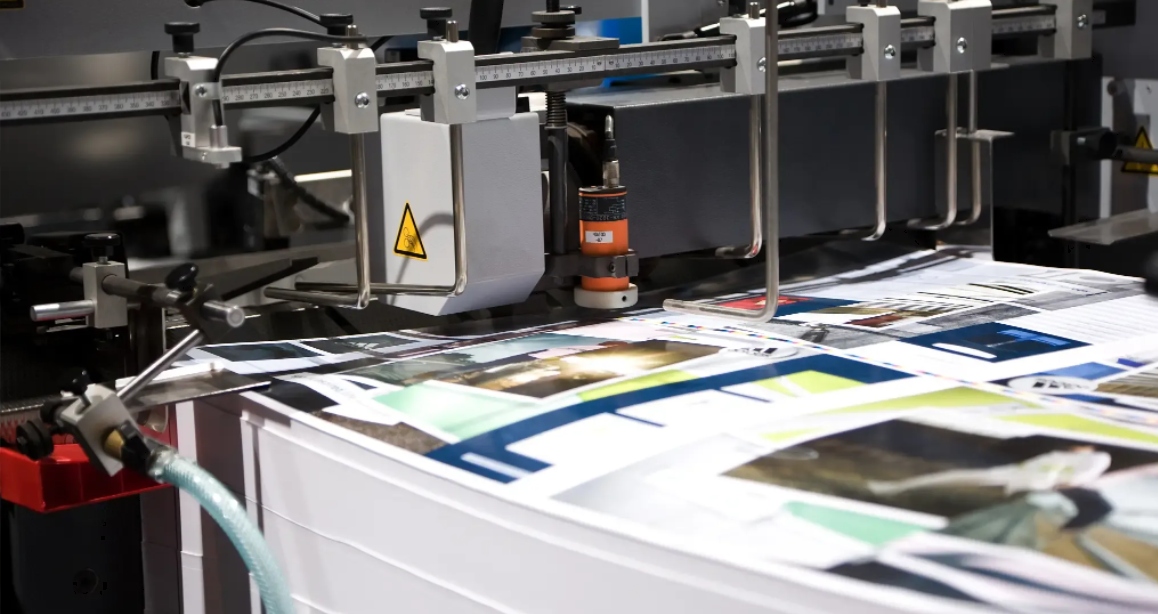
Choosing the right custom card manufacturer is one of the most important steps in ensuring successful custom card printing. A reliable card printing supplier not only provides consistent quality but also supports your project from design to final production. With many options available, evaluating key capabilities can help you select the best card printing factory for your needs.
Production Capability
A professional custom card manufacturer should have strong production capacity to handle both small and large orders. This includes the ability to produce different types of custom printed cards, such as tarot cards, playing cards, and trading cards, while maintaining consistent quality across batches.
Printing Technology
Advanced printing equipment is essential for high-quality custom card printing. A reliable card printing factory will use modern printing technology to ensure accurate colors, sharp details, and durable finishes. This is especially important for products that require premium visual effects or detailed artwork.
Quality Control
Consistent quality is a key factor when choosing a card printing supplier. A trusted custom card manufacturer should have strict quality control processes in place, including material inspection, color checks, and final product testing. This ensures that all custom printed cards meet the required standards before shipment.
OEM Services
Many businesses require OEM solutions when working with a custom card manufacturer such as @Jinguan Printing. A qualified card printing supplier should offer OEM services such as custom sizing, branding, packaging, and full production support. Partnering with an experienced card printing factory allows brands to scale production efficiently while maintaining product consistency.
Step-by-Step Process to Print Custom Cards
Understanding the custom card printing process helps businesses and creators manage projects more efficiently and avoid unnecessary delays. Whether you are launching a new product or scaling production, knowing how to print custom cards step by step ensures that your custom printed cards meet both quality and timeline expectations. Most professional custom card manufacturers follow a standardized workflow from design to delivery.
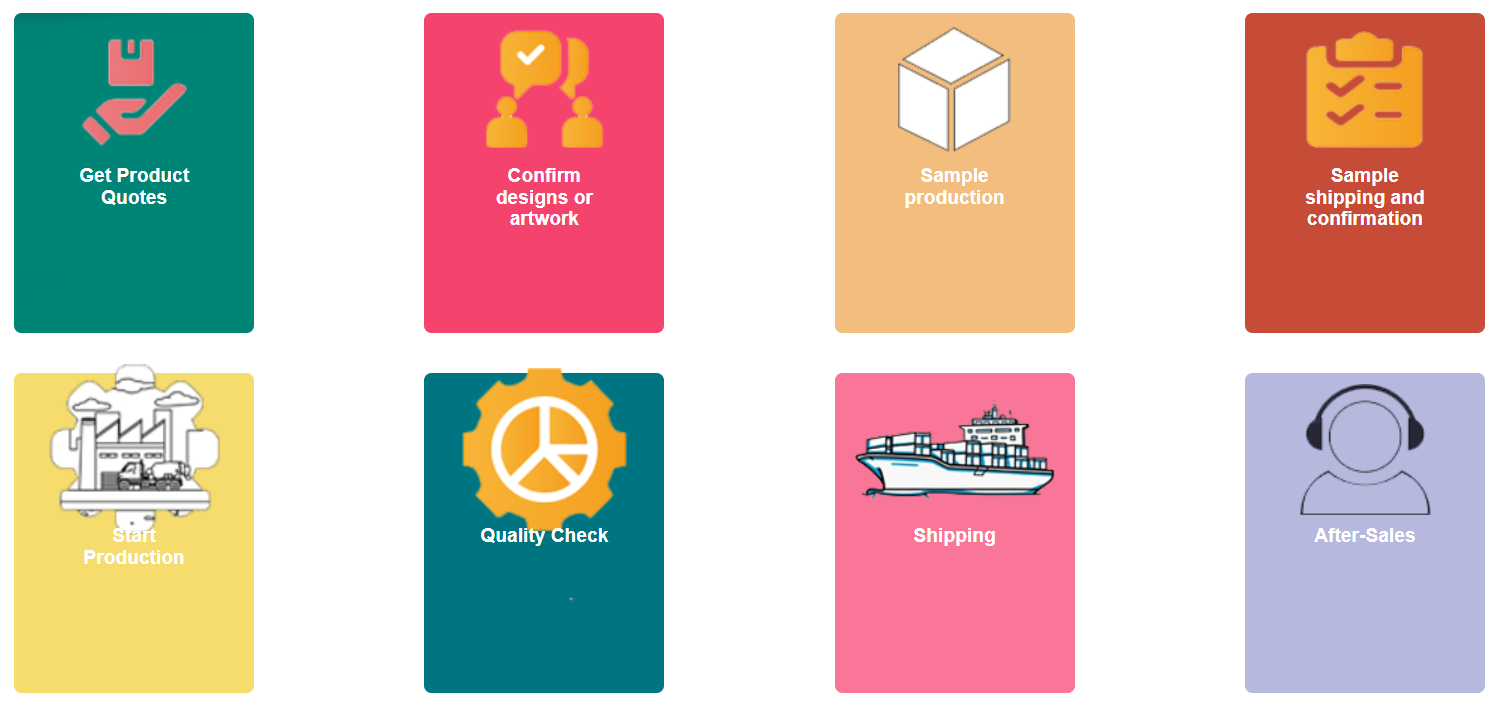
1. Design Preparation
The first step in how to print custom cards is preparing a print-ready design. This includes setting the correct card size, layout, bleed area, and resolution. Using a professional template provided by the custom card manufacturer helps ensure the artwork meets production requirements.
At this stage, brands finalize all visual elements, including graphics, text, and branding. A well-prepared design reduces errors and ensures a smoother custom card printing process.
2. Prototype and Sampling
Before mass production, most custom card manufacturers offer a sampling stage. Creating a prototype allows clients to review the physical quality of the custom printed cards, including color accuracy, card stock, and finishes.
This step is essential in the custom card printing process, as it helps identify potential issues early and ensures the final product meets expectations before large-scale production begins.
3. Mass Production
Once the sample is approved, the project moves into full production. During this stage, the custom card manufacturer handles printing, cutting, and finishing based on the confirmed specifications.
Efficient production is a key part of how to print custom cards at scale. A reliable partner ensures consistent quality across all custom printed cards, especially for bulk or bulk orders.
4. Packaging
After printing is complete, the cards are assembled and packed according to the selected packaging solution. This may include custom corrugated boxes, rigid boxes, or other custom card packaging options.
Proper packaging not only protects the custom printed cards during shipping but also enhances product presentation, making it an important step in the overall custom card printing process.
5. Shipping and Delivery
The final step in how to print custom cards is shipping. Depending on the order size and destination, products may be shipped by air or sea. A professional custom card manufacturer will help coordinate logistics to ensure timely delivery.
Understanding shipping timelines and costs is essential for completing the custom card printing process successfully and meeting market deadlines.
Common Mistakes to Avoid When Printing Custom Cards
Even with a clear custom card printing process, certain mistakes can lead to delays, increased costs, or unsatisfactory results. Understanding common custom card printing mistakes helps businesses avoid risks and improve the overall quality of their custom printed cards.
Choosing the Wrong Card Size
Selecting an incorrect card size is one of the most frequent custom card printing mistakes. Non-standard dimensions can increase production costs and may cause compatibility issues with packaging or accessories.
Using standard sizes recommended by a custom card manufacturer helps ensure efficiency and reduces unnecessary adjustments during production.
Low-Resolution Artwork
Poor image quality is another common issue in custom card printing. Low-resolution files can result in blurry or pixelated custom printed cards, which negatively impacts the final product.
To avoid this custom card printing mistake, all artwork should be prepared in high resolution (typically 300 DPI) and reviewed before submission to the card printing supplier.
Ignoring Packaging Design
Packaging is often overlooked, but it plays a critical role in both protection and branding. Inadequate or poorly designed packaging can lead to product damage during shipping and reduce perceived value.
Including proper custom card packaging in the planning stage helps avoid this custom card printing mistake and ensures the cards arrive safely while maintaining a professional appearance.
Skipping the Sampling Stage
Some businesses try to save time by skipping the sample approval process, which can lead to costly errors. Without reviewing a physical sample, issues with color, material, or finish may only be discovered after mass production.
Working with a professional custom card manufacturer and completing the sampling step is one of the most effective ways to prevent major custom card printing mistakes.
By understanding the full custom card printing process and avoiding these common custom card printing mistakes, businesses can ensure a smoother production experience and achieve high-quality results for their custom card projects.
FAQs
Q1: How to print playing cards?
A: To print playing cards, start with a print-ready design (correct size, bleed, 300 DPI), then work with a professional custom card manufacturer for sampling and mass custom card printing to ensure quality and consistency.
Q2: How to print a 5x7 card?
A: Set your document to 5x7 inches with proper bleed (usually 0.125”), export in high resolution, and submit to a card printing supplier for accurate custom printed cards production.
Q3: Print A5 card – what should I know?
A: A5 card printing requires proper layout setup, CMYK color mode, and high-resolution files. For bulk orders, working with a card printing factory ensures stable quality and cost efficiency.
Q4: How to print on a greeting card?
A: Use folded card templates, design both inside and outside pages, and choose suitable custom card paper. A custom card manufacturer can handle folding, printing, and finishing.
Q5: A6 card printing tips?
A: A6 cards are popular for postcards and invitations. Use 300 DPI artwork, standard sizes, and consider finishes like matte or gloss in your custom card printing project.
Q6: How to print on folded cards?
A: Design with fold lines in mind, keep important content away from creases, and confirm layout with your card printing supplier before production.
Q7: What is the best website to make custom cards?
A: It depends on your needs. For small orders, online tools work well. For bulk or branded projects, a professional custom card manufacturer offers better quality, pricing, and OEM services. If you have questions you would like answered, please contact us.
Q8: Is it better to print at 300dpi or 600dpi?
A: For most custom printed cards, 300 DPI is sufficient. 600 DPI may be used for highly detailed designs but increases file size without significant visual improvement.
Q9: What is a common mistake on business cards?
A: Low-resolution images, poor layout, and incorrect sizing are common issues. Always follow the custom card printing process and confirm with your card printing supplier.
Q10: How do I make my own custom cards?
A: Prepare your design, choose materials and finishes, request samples, and proceed with a trusted custom card manufacturer for full custom card printing production.